Monday, 23 November 2015

changes to box design using 60s high end psychedelic art

A massive change to my box layout is the back ground style.I decided to go with brighter colours as it makes my design more interesting and a lot more catchy.By making this change it helps me make my advertisments. Some art work i plan to take inspiration from is pictures like this;
I really like the minimalistic but still full art work that has been made here.


I have already made my leaflet in this kind of style and can easily make my billboard this way as well.
My biggest inspiration and what i plan to make my box to represent is the below picture:
This picture was done by Laura Gentians is one of the biggest inspirations to my artwork.I loved the way the multicolour drips splatter down the page.

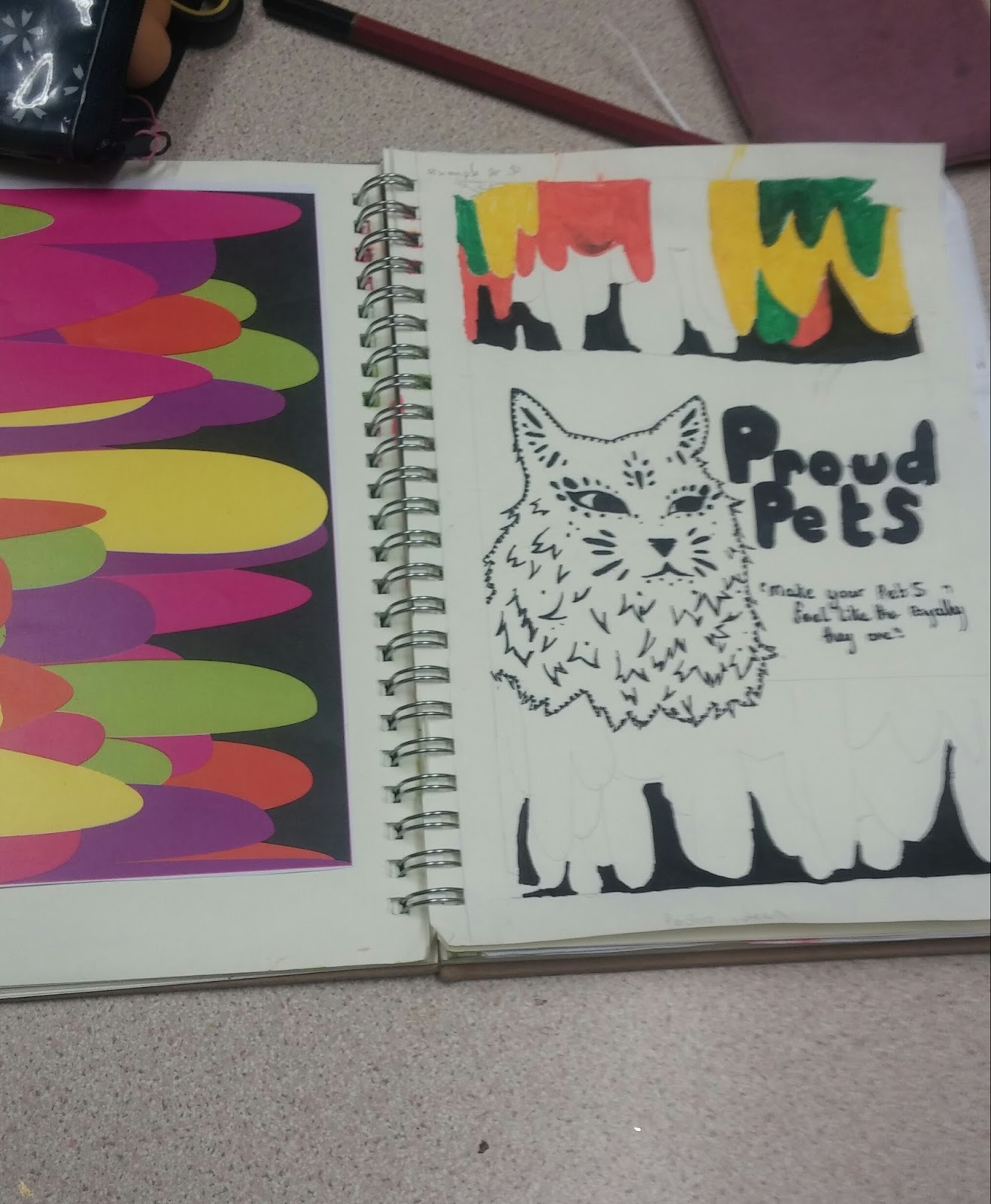
here is my rendition of this idea and what i plan to use on my box and other ideas:
This is a lot bigger version  of the last design and a more simple one as well.


Thursday, 19 November 2015

Bauhaus

Notes;
The Bauhaus was first founded by Walter Gropius in Weimar. In spite of its name, and the fact that its founder was an architect, the Bauhaus during the first years of its existence did not have an architecture department. Nonetheless, it was founded with the idea of creating a "total" work of art in which all arts, including architecture, would eventually be brought together. The Bauhaus style later became one of the most influential currents in modern design, Modernist architecture and art, design and architectural education.The Bauhaus had a profound influence upon subsequent developments in art, architecture, graphic design, interior design, industrial design, and typography.

he "Degenerate Art" exhibit held in Munich in 1937 was the end of modern art in Nazi Germany and the beginning of Nazi Art. The author examines some of the art shown at that exhibit.
Barr, the director of the Museum of Modern Art from its inception in 1928 until 1943, displayed "almost prophetic insight" on his visit to Stuttgart at the very beginning of Nazi rule in 1933. In Stuttgart, Barr found that The "Battle Band for German Culture", an early official Nazi group with affiliates in every important German city, dominated almost every phase of German cultural life right from the beginning of the Nazi regime. He also found that modern art, offensive to the Third Reich, was attacked in Stuttgart, a city which had embraced the modern International Style in art and architecture - a reasonable attachment since the International Style was German in origin.
Wassily Kandinsky
A member of the German Expressionist group Der Blaue Reiter, and later a teacher at the Bauhaus, Kandinsky is best known for his pioneering breakthrough into expressive abstraction in 1913. His work prefigures that of the American Abstract Expressionists.
Josef Albers
Josef Albers was a German-born American painter and teacher. Celebrated as a geometric abstractionist and influential instructor at Black Mountain College, Albers directly influenced such artists as Robert Rauschenberg, Cy Twombly and Ray Johnson.
Laszlo Moholy-Nagy
Laszlo Moholy-Nagy was a Hungarian painter, photographer and teacher at the Bauhaus School. Moholy-Nagy was influential in promoting the Bauhaus's multi- and mixed-media approaches to art, advocating for the integration of technological and industrial design elements.
Ludwig Mies van der Rohe
Ludwig Mies van der Rohe was one of the founding fathers of architectural Modernism. Utilizing modern materials and mass production strategies, his buildings rejected surface ornament in favor of a sleek and imposing geometry.
Johannes Itten (11 November 1888 – 25 March 1967) was a Swiss expressionist painter, designer, teacher, writer and theorist associated with the Bauhaus (Staatliche Bauhaus) school. Together with German-American painter Lyonel Feininger and German sculptor Gerhard Marcks, under the direction of German architect Walter Gropius, Itten was part of the core of the Weimar Bauhaus.
Oskar Schlemmer (4 September 1888 – 13 April 1943) was a German paintersculptordesigner and choreographer associated with the Bauhaus school. In 1923 he was hired as Master of Form at the Bauhaus theatre workshop, after working some time at the workshop of sculpture. His most famous work is "Triadisches Ballett," in which the actors are transfigured from the normal to geometrical shapes. Also in Slat Dance and Treppenwitz, the performers' costumes make them into living sculpture, as if part of the scenery.chlemmer became known internationally with the première of his 'Triadisches Ballett' in Stuttgart in 1922. His work for the Bauhaus and his preoccupation with the theatre are an important factor in his work, which deals mainly with the problematic of the figure in space. People, typically stylised faceless female figures, continued to be the predominant subject in his painting. While at Bauhaus, he developed the multidisciplinary course "Der Mensch (The human being)." In the human form he saw a measure that could provide a foothold in the disunity of his time. After using Cubism as a springboard for his structural studies, Schlemmer's work became intrigued with the possibilities of figures and their relationship to the space around them, for example 'Egocentric Space Lines' (1924). Schlemmer's characteristic forms can be seen in his sculptures as well as his paintings. Yet he also turned his attention to stage design, first getting involved with this in 1929, executing settings for the opera 'Nightingale' and the ballet 'Renard' by Igor Stravinsky.

Bauhaus
House mad be bauhaus worksop.was made as a dream about a better world.Also made affordable.Designed a kitchen using ceramics and glasses as well.1923 hyperflation stopped the houses being sold in mass and jobs started to loss.At this time Nazis marched through the streets protesting.Soon after the college closed 1925 due to this (national social party which where Nazis).1924 political arts had the depression and prohibited money to try compensate for the devalue.was closed before it could be closed(reopened destroying desseou) which was better a more natural home less then a year to build.designed things for workshops metal replaced wood,chairs were inspired by cars and such.experiments were made with double montage and over printing.bold simple designs rethought ht along with text and everything was possible.Dixeland
They were seen as Punks.

Second director.Second director communist Hannes Meyer's took the place of groupeus 1929.1930 Ludwig was appointed as the next Bauhaus director.actetictual study's were topped and was closed as nazis thought it to be a pit of Jewish ideas.

Georg Muche

nvited Muche in 1919 to join the Bauhaus faculty in Weimar.At Bauhaus, he headed the weaving workshop from 1919 to 1925 and directed the preliminary course from 1921 to 1922.Muche was in charge of the 1923 Bauhaus Exhibition, their first major exhibition,[5] for which he designed an experimental house known as "Haus am Horn". It was constructed in 1923 as the first practical implementation of the new Bauhaus building style. Such principles were key influences on 20th-century architecture.Of the original Bauhaus buildings in Weimar, Haus am Horn is the only one still standing.[8] Muche was the leading proponent of the Bauhaus architectural group. In 1926 he, along with Richard Paulick, designed the innovative Stahlhaus (Steel House) at Dessau-Törten.[5][7] From 1925 to 1927 he headed the Bauhaus' weaving workshop in Dessau.

Gunta Stölzl (5 March 1897 – 22 April 1983) was a German textile artist who played a fundamental role in the development of the Bauhaus school’s weaving workshop. As the Bauhaus’s only female master she created enormous change within the weaving department as it transitioned from individual pictorial works to modern industrial designs. She joined the Bauhaus as a student in 1920, became a junior master in 1927 and a full master the next year. She was dismissed for political reasons in 1931, two years before the Bauhaus closed under pressure from the Nazis.She soon became a mentor to other students and reopened the Bauhaus dye studios in 1921. After a brief departure, Stölzl became the school's weaving director in 1925 when it relocated from Weimar to Dessau and expanded the department to increase its weaving and dyeing facilities. She applied ideas from modern art to weaving, experimented with synthetic materials, and improved the department's technical instruction to include courses in mathematics. The Bauhaus weaving workshop became one of its most successful facilities under her direction.

Monday, 2 November 2015

billboard and advertisements

Below is just a place holder as i will be taking a picture;
(i will be taking one)
Practice and ideas for my billboard that will be used to both show case and show off)my product to protectional clients. Those who will be driving past will automatically see my eye catching product and very quick explanation of what it is.This is a quick and easy way to sell products as it opens up to a wider audiences my intend audience were those who would read cat magazinces.
I will also be doing a bus stop advert and a small magazine one as well just so i have a bigger range to play with.

Reference i will be using for my billboard

Billboard idea with border.
Cat billboard idea using simple cat
NO GOOD!
Final poster ideas and example i will work from:
ideas for the content including simple style  
 illustrations idea using simple pen on one colour(psycoldelic idea)
using simple cartoons(my style).
Pre poster and possible advertisement layout using my sketchy I did earlier and pack pens.
the page on the left gives a more accurate showing of what I want to achieve but the right gives the particular layout.The fonts are a. little off though as they have been hand drawn and I am still working on drawing my actually product over the coloured parts.
Over all this is a good design and I feel that it is stronger then.my last ones. I will keep on working on this design either way.
Here is the computer version I hope to complete asap:
My next job with this would be to add the cat and small writing(which i have forgot).
I really like how this has turned out especially since i turned the pattern around.


Cat details for both poster and board;
With this one i have added thick lines to define the cat more.I have removed the details on the head and have instead added details on the chest.
Maybe i will make the lines a little less bold and put a few features back on.
i feel that this one is a lot better with the changes i made;


Further advertising (billboard)
using the high end drip effect and other resources i have drawn up in my sketch pad:
Black outline of my product that i used to go in the back ground.Blends in the right amount as well.
as seen below is the start of my new design:
(1)
(2)

This (those may) will be the back ground to my billboard thats includes my products in the back ground.
I have yet to add a cat to the design but my idea is to have it with thicker lines and have it bolder then the back ground.I have a few sketches in my book that i can work from. 
I took a totally different approach to my billboard idea with a big bold font and several other changes.
update and changes to idea;

Idea without the right handsome border making it feel less inclusive of the space.
Advert used as example.


Tuesday, 13 October 2015

Richard slee

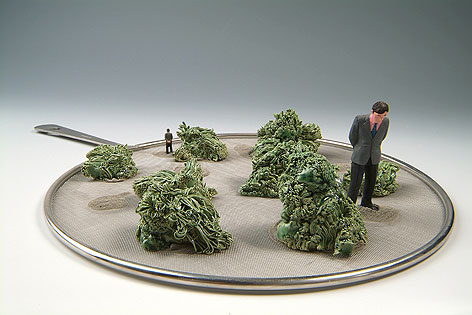
A example of his work 


He studied at Carlisle College of Art and Design (1964–65), at the Central School of Art and Design (1965–70), from where he graduated with a first-class honours degree in ceramics, and at the Royal College of Art (1986–88).
Slee has been professor of ceramics at Camberwell College of Arts, London since 1992 and was awarded the Jerwood Prize for Ceramics in 2002.

Monday, 12 October 2015

updated box idea(testing)

Box used:


As you can see this is only a simple pro to type that will be used for improving my product design.It has highlighted the fact that i will need to make the writing a little lighter.Also i am not a massive fan of the grey tabs i shall have to research approprate colours for a pet product.Another thing is that i appear to have stretched the logo to much and it looks really bad.
Things that i do like is the idea of the box looking like it has actual cat fur on it.
The actually box shape is okay but i will be enlarging everything but the tabs themeselves
logo used:
This logo was used using my previous idea of having a simple cat outline and having writing underneith it.I have a lot of ideas that stem from this design and how simplistic. 
there are lines used on that cat that would back curves.
I like the colour of my logo and I'm intent in keeping it black. 

(Further updates to my ideas is to do a different box for each fur type i.e Short,long and medium lengths)

Major update and front(excluding actually back ground);
The image has been updated with a new style of cat with a larger text.
The background will not be yellow.


Thursday, 8 October 2015

SMART GOALS AND TARGETS

Once you have planned your project, turn your attention to developing several goals that will enable you to be successful. Goals should be SMART - specific, measurable, agreed upon, realistic and time-based.
A goal might be to hold a weekly project meeting with the key members of your team or to organise and run a continuous test programme throughout the project.
The acronym SMART has a number of slightly different variations, which can be used to provide a more comprehensive definition for goal setting:
S - specific, significant, stretching
M - measurable, meaningful, motivational
A - agreed upon, attainable, achievable, acceptable, action-oriented
R - realistic, relevant, reasonable, rewarding, results-oriented
T - time-based, time-bound, timely, tangible, trackable
This provides a broader definition that will help you to be successful in both your business and personal life.

Tuesday, 6 October 2015

Arts and crafts movments

The Arts and Crafts Movement was one of the most influential, profound and far-reaching design movements of modern times. It began in Britain around 1880 and quickly spread across America and Europe before emerging finally as the Mingei (Folk Crafts) movement in Japan.
It was a movement born of ideals. It grew out of a concern for the effects of industrialisation: on design, on traditional skills and on the lives of ordinary people. In response, it established a new set of principles for living and working. It advocated the reform of art at every level and across a broad social spectrum, and it turned the home into a work of art.
Information taken from:
http://www.vam.ac.uk/content/articles/t/the-arts-and-crafts-movemen
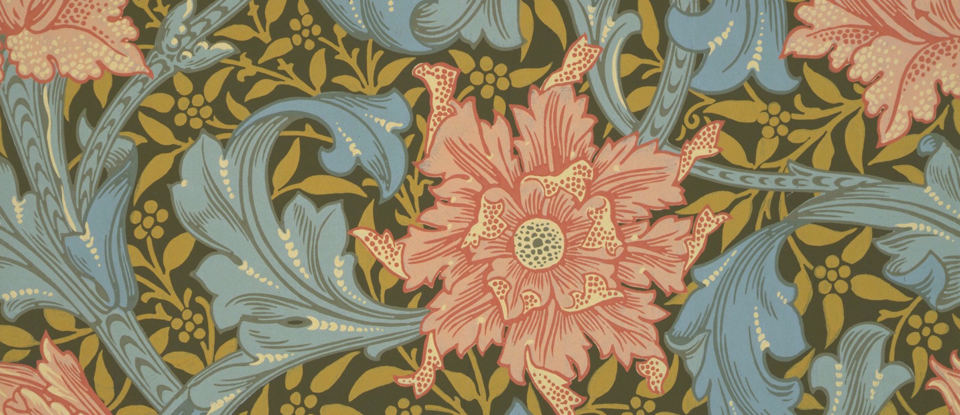
Some examples of the Arts and crafts movements:

Some artists that were in the Arts and crafts movments :
The two most influential figures were the theorist and critic John Ruskin and the designer, writer and activist William Morris.
Have nothing in your house that you do not know to be useful, or believe to be beautiful.

John Ruskin
His writings predicted and commented on social issues such as environmentalism, sustainability, craftsmanship, and fulfilling labor. Most importantly for the Arts and Crafts Movement to come, Ruskin called for a revival of traditional craftsmanship and a return to the spiritual values of handcrafting from natural materials.
Ruskin was keenly interested in the Gothic Revival and promoted that the preservation and restoration of the Gothic architecture of the Middle Ages was a vital activity. During this period Ruskin also began writing in support of Pre-Raphaelitism and Pre-Raphaelite artists.
Taken from:
http://www.arts-and-crafts-style.com/John-Ruskin.html

Environmentalism or Environmental rights is a broad philosophy, ideology and social movement regarding concerns for environmental protection and improvement of the health of the environment, particularly as the measure for this health seeks to incorporate the concerns of non-human elements. 
Theology is the systematic and rational study of concepts of God and of the nature of religious ideas, but can also mean the learned profession acquired by completing specialized training in religious studies, usually at a university, seminary, or school of divinity.

Alponse Mucha
Painter and Decorator
First painting that started his career was of a raging actress that needed a poster for her play.From then him and his style became renowned. His paintings include figures in a very colourful painting style.From his first job he was then entered into a 6 year contract.

Oscar Fingal O'Flahertie Wills Wilde
as an Irish playwright, novelist, essayist, and poet. After writing in different forms throughout the 1880s, he became one of London's most popular playwrights in the early 1890s.Known for his biting wit, flamboyant dress and glittering conversation, Wilde became one of the best-known personalities of his day.The Marquess was the father of Wilde's lover, Lord Alfred Douglas. The charge carried a penalty of up to two years in prison. The trial unearthed evidence that caused Wilde to drop his charges and led to his own arrest and trial for gross indecency with men. After two more trials he was convicted and imprisoned for two years' hard labour.

His burial;
Wilde was initially buried in the Cimetière de Bagneux outside Paris; in 1909 his remains were disinterred and transferred to Père Lachaise Cemetery, inside the city.His tomb was designed by Sir Jacob Epstein,commissioned by Robert Ross, who asked for a small compartment to be made for his own ashes which were duly transferred in 1950. The modernist angel depicted as a relief on the tomb was originally complete with male genitalia which have since been vandalised; their current whereabouts are unknown. In 2000, Leon Johnson, a multimedia artist, installed a silver prosthesis to replace them.